
You have found a home, negotiated a purchase price, and started working toward closing. Then the appraisal comes back lower than the amount you agreed to pay. Suddenly, the transaction may need another round of negotiations.
A low home appraisal in Southern Maryland can affect buyers and sellers throughout St. Mary's, Calvert, and Charles counties. It can create financing challenges, change how much cash a buyer needs at closing, or require both parties to reconsider the agreed purchase price.
The good news is that a low appraisal does not automatically mean the sale is over.
Understanding what the appraisal means, how lenders respond, and which options may be available can help everyone make informed decisions.
What Does It Mean When a Home Appraisal Comes in Low?
A home appraisal is an independent professional opinion of a property's market value. Mortgage lenders generally require appraisals to help determine whether the property provides sufficient collateral for the loan.
A low appraisal occurs when the appraiser's opinion of value is below the property's agreed purchase price.
For example, imagine a buyer and seller agree on a home in Leonardtown for $400,000, but the appraisal comes back at $380,000.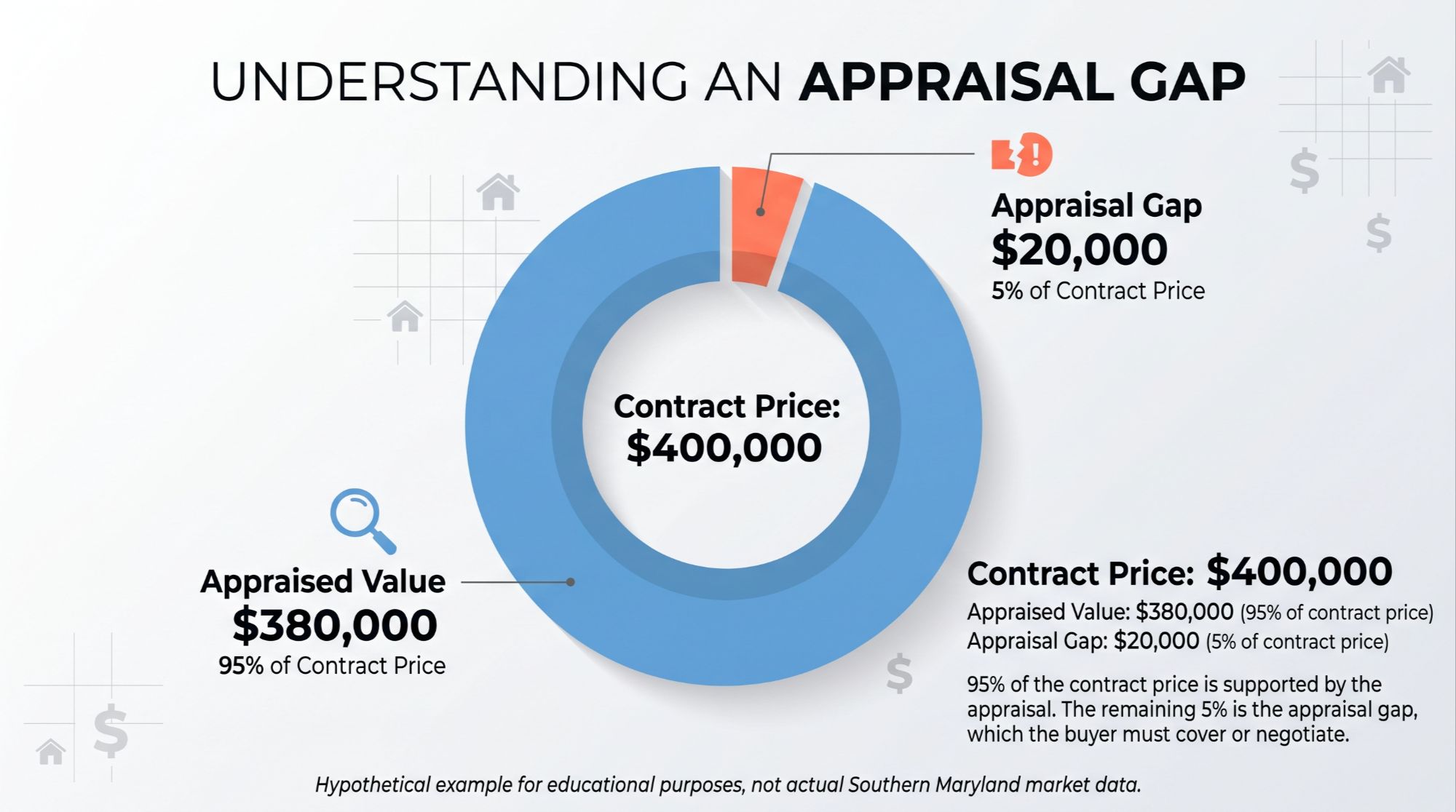
The $20,000 difference does not necessarily mean the buyer must bring exactly $20,000 more to closing. The actual cash requirement depends on the loan program, down payment, lender requirements, and any negotiated changes to the purchase price.
Lenders commonly calculate loan-to-value ratios using the lower of the purchase price or appraised value. That can change the financing available for a transaction.
Why Do Home Appraisals Come in Lower Than Expected?
An appraisal can differ from the agreed purchase price for several reasons. A buyer's willingness to pay a certain amount does not necessarily establish the value an appraiser can support.
Comparable home sales
Appraisers analyze recent sales of properties with relevant similarities, including location, size, condition, and features.
In Southern Maryland, finding closely comparable sales can sometimes be challenging when properties have unusual acreage, waterfront access, outbuildings, or other distinctive characteristics.
For example, a waterfront property in Lusby may require a different set of comparable sales than a typical subdivision home in Waldorf.
Property condition and improvements
An appraiser considers the property's condition and features. Renovations may contribute value, but the amount invested in improvements does not automatically translate into an equal increase in appraised value.
A seller who recently completed an expensive kitchen renovation may not receive a dollar-for-dollar increase in the appraisal.
Differences between listing price and market evidence
A home's asking price is a marketing decision. Its contract price reflects what a particular buyer and seller agreed upon. An appraisal is a separate opinion developed from available market evidence.
These three amounts can differ.
Changing market conditions
When prices, inventory, or buyer demand change, recent comparable sales may not fully align with current contract prices.
This does not establish that any particular Southern Maryland county is experiencing rising or falling prices. Current conditions should be evaluated using recent, location-specific sales data.
What Are a Buyer's Options After a Low Appraisal?
A low appraisal can be frustrating, particularly after a buyer has invested time in inspections, financing, and moving plans.
However, several potential solutions may be available.
Negotiate a lower purchase price
One option is to ask the seller to reduce the purchase price to the appraised value or another mutually acceptable amount.
Using the earlier example, the buyer might request that the $400,000 purchase price be reduced to $380,000.
The seller is not automatically required to accept that request. Whether the buyer can terminate the transaction depends on the contract.
Cover some or all of the appraisal gap
A buyer may decide to contribute additional funds if the lender approves the financing structure and the buyer has sufficient resources.
Sometimes the parties compromise.
For example, the seller might agree to reduce the price by $10,000 while the buyer agrees to cover the remaining difference.
Before committing additional funds, buyers should speak with their lender about how the appraisal affects the down payment, loan-to-value ratio, mortgage insurance, and cash needed to close.
Buyers who are still preparing for a purchase can review the steps involved in mortgage pre-approval.
Request a reconsideration of value
If the appraisal contains factual errors, overlooks relevant comparable sales, or relies on inaccurate property information, the buyer can ask the lender about a reconsideration of value.
A reconsideration is a formal process for asking the appraiser to review additional information or possible errors.
It is not a guarantee that the appraised value will change.
Cancel the purchase if the contract permits
Some purchase agreements contain appraisal or financing contingencies that may allow a buyer to terminate under specified conditions.
However, the buyer must follow the actual contract language, including applicable notice requirements and deadlines.
A low appraisal alone does not guarantee that the buyer can cancel without consequences.
What Can Sellers Do When the Appraisal Comes in Low?
For sellers, a low appraisal may create uncertainty after accepting an offer.
The first step is to understand why the appraised value differs from the contract price rather than immediately assuming the sale cannot proceed.
Review the appraisal information. Work with the appropriate transaction professionals to determine whether the report contains factual errors or omits relevant property features. The lender generally controls the appraisal review process.
Evaluate the buyer's financing. A buyer with sufficient available funds may be able to proceed without a price reduction, subject to lender approval.
Consider a negotiated adjustment. Depending on the circumstances, reducing the price or agreeing to a compromise may be preferable to returning the property to the market.
Review the alternatives. A seller can consider whether continuing with the current buyer makes sense compared with the uncertainty, carrying costs, and time involved in finding another buyer.
A new contract does not guarantee a higher appraisal. Future appraisals may use similar comparable sales, although each appraisal is a separate professional opinion.
Sellers preparing to list can explore Southern Maryland seller resources and request a home valuation to begin evaluating their pricing strategy.
A comparative market analysis and a lender-ordered appraisal serve different purposes, so one should not be presented as a substitute for the other.
How Does an Appraisal Contingency Protect Buyers in Maryland?
An appraisal contingency is a provision that may give a buyer certain rights when a property appraises below an agreed threshold.
The protection depends on the wording of the signed contract.
Some agreements contain a specific appraisal contingency. Others address appraisal-related financing problems through a financing contingency. Buyers may also agree to cover a defined appraisal gap or waive certain protections.
These provisions are not interchangeable.
What happens to the earnest money deposit?
Whether a buyer can recover earnest money after a low appraisal depends on the contract, the reason for termination, and whether the buyer complied with required procedures.
A buyer who has a valid contractual termination right and properly exercises it may be entitled to a deposit return under the agreement.
A buyer who terminates without an applicable contractual right may face a dispute or potential loss of the deposit.
Maryland buyers and sellers should have their real estate professional explain the transaction procedures and consult a qualified Maryland real estate attorney when contract interpretation or deposit rights are disputed.
Why deadlines matter
Appraisal and financing contingencies may include specific notice periods, documentation requirements, and deadlines.
Missing a deadline can affect contractual rights.
Before agreeing to cover an appraisal gap or waive an appraisal contingency, buyers should understand the financial commitment and the potential consequences if the appraisal comes in low.
Can You Challenge a Low Home Appraisal?
Yes. A low appraisal can sometimes be reviewed through the lender's reconsideration-of-value process.
However, simply disagreeing with the number is not enough. A strong request should identify specific information that may justify another review.
Useful supporting information may include:
- Incorrect square footage, property features, or condition details.
- Relevant comparable sales that were overlooked.
- Documented improvements that were not accurately reflected.
- Possible errors in the report's analysis or adjustments.
The buyer should contact the lender to understand its procedures. The lender generally coordinates the reconsideration request with the appraiser.
According to Fannie Mae's reconsideration-of-value guidance, borrowers may raise concerns about appraisal accuracy through a formal process for applicable loans.
An appraiser may revise the valuation, clarify the original conclusion, or determine that no change is warranted.
Ordering another appraisal is not automatically available simply because the original value was disappointing. The lender and loan program determine whether another appraisal is appropriate.
How Southern Maryland Buyers and Sellers Can Prepare for Appraisal Issues
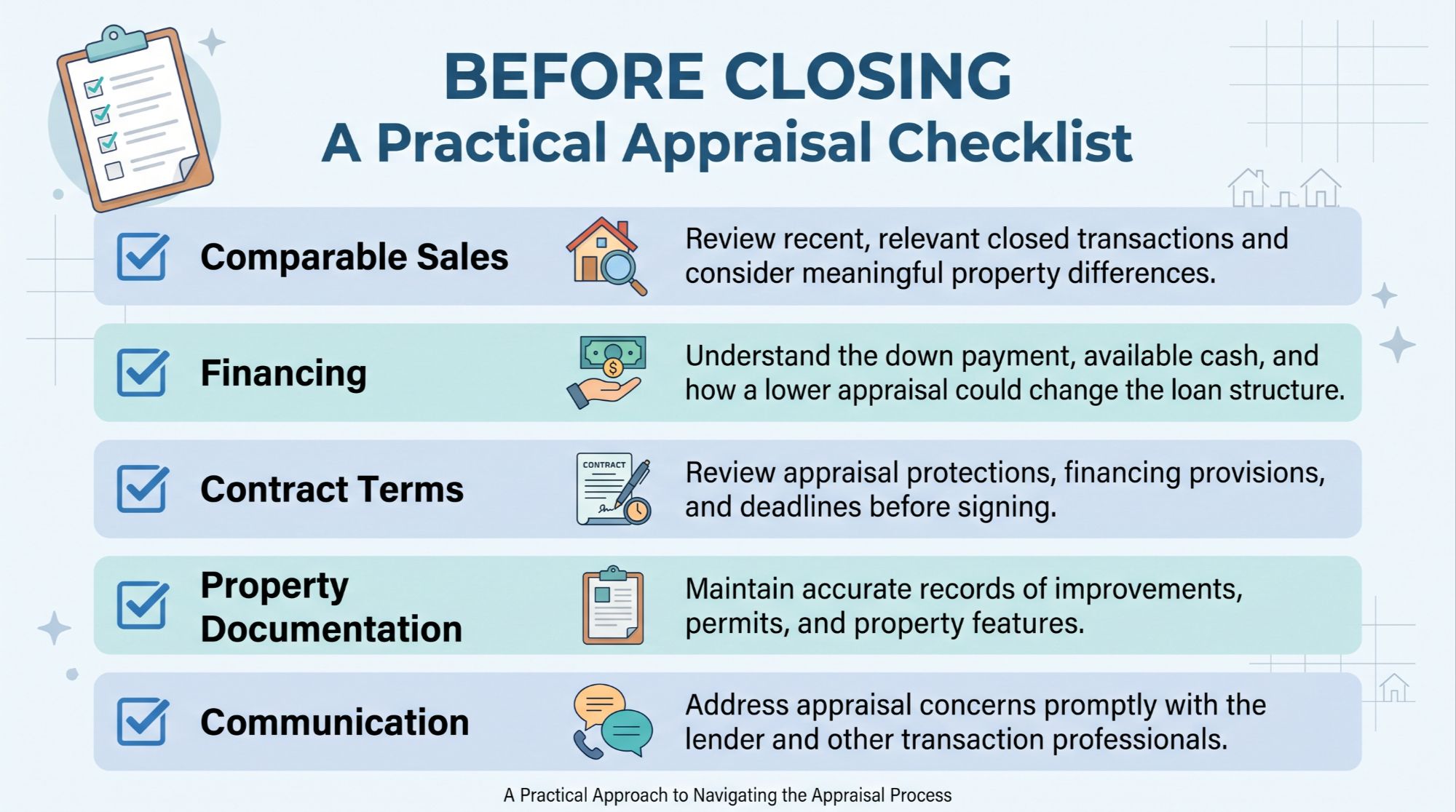
Although no one can guarantee an appraisal result, preparation can help buyers and sellers understand potential risks before they become closing problems.
For buyers, the starting point is evaluating the offer price against relevant comparable sales, not simply relying on the asking price.
For sellers, pricing decisions should reflect the property's condition, location, features, and recent market evidence.
Local property differences can be significant across Southern Maryland.
A home in Lexington Park may have a different set of comparable properties than a home in Prince Frederick or La Plata.
Buyers can also browse available Southern Maryland homes to explore property options while working with a local real estate professional to interpret comparable sales.
A low appraisal is a financing and negotiation issue, not necessarily a final judgment about whether a property is worth purchasing.
The appropriate response depends on the property's characteristics, the buyer's financial position, the seller's priorities, and the terms of the agreement.
Frequently Asked Questions About Low Home Appraisals
Does a seller have to lower the price after a low appraisal?
No. A low appraisal does not automatically require a seller to reduce the agreed purchase price. The buyer and seller may negotiate a new price, explore other financing arrangements, or exercise any applicable contractual rights.
Can a buyer lose earnest money after a low appraisal?
Yes, depending on the contract. A buyer who terminates without a valid contractual right may risk losing earnest money. Appraisal and financing contingencies can provide protections, but the buyer must follow the agreement's specific requirements.
Can a second appraisal come in higher?
Yes. Appraisals are professional opinions, and different appraisers may reach different supported conclusions. However, the lender determines whether another appraisal is permitted or necessary. A second appraisal does not guarantee a higher value.
Does a low appraisal affect a VA loan differently?
VA-financed purchases have additional appraisal procedures. The VA's Tidewater process can provide an opportunity to submit relevant market information when an appraiser anticipates a value below the contract price.
VA appraisals also involve a Notice of Value and program-specific reconsideration procedures. Buyers should discuss the applicable process with their lender and review official VA appraisal training and guidance.
Need Help Navigating a Low Home Appraisal in Southern Maryland?
Whether you're buying a home in St. Mary's County, selling a property in Calvert County, or preparing for a move in Charles County, appraisal issues can raise important questions about pricing, financing, and negotiation.
The Southside Group Real Estate, led by Billy Rabbitt, helps Southern Maryland buyers and sellers navigate real estate transactions with practical local guidance.
If an appraisal has created uncertainty in your transaction, contact The Southside Group Real Estate to discuss your next steps.
For financing questions, consult your mortgage lender. For questions about contractual rights, consult a qualified Maryland real estate attorney.
FROM OUR BLOG


What Can a $3,200 Monthly Housing Budget Buy in Southern Maryland?
A buyer reached out to our team over the weekend with a practical question: “What could I afford if I wanted to spend about $3,100 to $3,200 a month?” It’s a good starting point for understanding Southern Maryland home affordability. Before you set a maximum price on your home search, you need to kn

Calvert County Events This Weekend | November 19–22, 2026
Calvert County events this weekend offer a wonderful mix of family-friendly activities, waterfront gatherings, hands-on workshops, holiday shopping, and local entertainment. From Thursday, November 19, through Sunday, November 22, 2026, communities throughout Southern Maryland have plenty of opportu

Charles County Events This Weekend | November 19–22, 2026
Charles County events this weekend offer plenty of opportunities to connect with the community, enjoy local entertainment, discover holiday shopping, and explore activities throughout Southern Maryland. From November 19–22, 2026, residents and visitors can find networking gatherings, live performanc