
Things to do before applying for a home loan include reviewing your credit, getting your financial documents organized, evaluating your budget, avoiding unnecessary financial changes, and learning about mortgage programs that may fit your situation. For Southern Maryland home buyers, taking these steps before applying for financing can make it easier to understand your options and prepare for conversations with a mortgage lender.
Whether you're a first-time buyer, relocating to Southern Maryland, purchasing another home, or considering an investment property, mortgage preparation should begin before you start seriously shopping.
Here are some of the most important steps to consider.
1. Review Your Credit Before Applying for a Home Loan
Your credit history is one of several factors a mortgage lender may consider when reviewing an application. Before applying, review your credit reports so you know what a lender may see.
Look for issues such as:
-
Accounts you don't recognize
-
Incorrect balances or payment information
-
Late payments
-
High revolving credit balances
-
Collection accounts
-
Errors in your personal information
If you discover information you believe is inaccurate, learn about the appropriate process for disputing it with the credit reporting agencies.
Avoid assuming that you must reach one particular credit score before talking with a lender. Mortgage programs and lenders can have different eligibility standards.
What Is the Minimum Credit Score Required to Buy a House in Maryland?
There is not one universal minimum credit score required to buy a house in Maryland.
Credit requirements can depend on the mortgage product, lender, borrower profile, mortgage insurance requirements, and assistance program being used. Certain Maryland Mortgage Program products may also have their own eligibility requirements.
Instead of relying on a credit-score number you found online, talk with an approved or qualified mortgage lender about the programs available for your circumstances.
Even if you're not ready to apply today, understanding where your credit stands can help you determine what to work on before beginning your Southern Maryland home search.
2. Get Your Financial Documents Organized
One of the most practical things to do before applying for a home loan is to organize your financial paperwork.
Mortgage lenders typically need documentation to verify different parts of a borrower's financial profile. Exactly what is required varies depending on the borrower and loan program.
Documents you may be asked to provide can include:
-
Recent pay statements
-
W-2s or other income documentation
-
Federal tax returns when applicable
-
Bank and asset statements
-
Employment information
-
Identification
-
Documentation related to existing debts
-
Information about other sources of income or assets when applicable
Self-employed buyers, investors, and buyers with nontraditional income may be asked for additional documentation.
Getting organized early can save you from searching for important documents after the application process has already started.
Keep Your Information Consistent and Accurate
Your mortgage application and supporting documents should accurately reflect your financial situation.
Don't guess when you don't know an answer, and don't intentionally leave out information because you think it could hurt your application.
If something about your income, employment, assets, or debts is unusual, discuss it with your lender and ask what documentation may be required.
3. Understand Your Budget Before Mortgage Pre-Approval
A lender's pre-approval can help you understand how much financing you may qualify for, but qualification and personal affordability are not necessarily the same thing.
Before applying, look closely at your own monthly budget.
Consider more than the purchase price of the home. Depending on the property and transaction, homeownership expenses can include:
-
Mortgage principal and interest
-
Property taxes
-
Homeowners insurance
-
HOA or condominium fees
-
Utilities
-
Maintenance and repairs
-
Moving expenses
-
Future improvements
Your lender can explain the financing-related costs and estimates associated with your mortgage options.
Meanwhile, you should decide what monthly housing expense feels sustainable for your household.
This distinction can be especially helpful when comparing homes across St. Mary's County, Charles County, and Calvert County, where property characteristics, taxes, association fees, insurance considerations, and other expenses can vary.
4. Build Your Available Funds Before Buying a Home
Home buyers commonly focus on the down payment, but that isn't necessarily the only money you'll need during a purchase.
Depending on your transaction, you may need funds for expenses such as:
-
Down payment
-
Earnest money deposit
-
Closing-related expenses
-
Home inspection
-
Moving expenses
-
Immediate repairs or purchases
-
Cash reserves after closing
The amounts vary considerably by loan and transaction, so avoid assuming that a generic percentage or online calculator tells you exactly how much cash you'll need.
Ask your lender for estimates based on the mortgage options you're considering.
It's also wise to think about life after closing. Buying a home without leaving yourself any financial cushion can make an unexpected repair or expense much harder to handle.
5. Know the Red Flags on a Mortgage Application
What Are Red Flags on a Mortgage Application?
A mortgage lender may need additional information when an application contains inconsistent documentation, unexplained financial activity, new debts or credit accounts, significant changes in income or employment, or information that cannot be readily verified.
A red flag doesn't automatically mean a mortgage will be denied. It may simply mean the lender needs more documentation or an explanation.
The best approach is transparency.
Provide accurate information and respond promptly when your lender requests supporting documents.
What Is the Golden Rule for Getting a Home Loan?
There isn't an official mortgage-industry “golden rule,” but buyers can follow one practical principle:
Keep your finances as consistent as possible, provide complete and accurate information, and talk with your lender before making a major financial change.
Once you're preparing for a mortgage or have been pre-approved, be particularly careful about making significant changes without discussing them with your lender.
That can include:
-
Financing a vehicle
-
Opening new credit accounts
-
Making large purchases with credit
-
Changing jobs or employment arrangements
-
Moving substantial amounts of money without keeping documentation
-
Co-signing for another person's debt
Individual circumstances differ. If you need to make a financial change, contact your loan officer first and ask how it could affect your application.
6. Research Maryland First-Time Homebuyer Programs
Southern Maryland buyers should also investigate whether they may qualify for homeownership assistance or specialized mortgage programs.
The Maryland Mortgage Program (MMP) provides home loan programs and related homeownership resources for eligible Maryland buyers. Program eligibility and requirements vary, so buyers should review current information and speak with an approved lender rather than relying on outdated program summaries.
Who Qualifies as a Maryland First-Time Home Buyer?
For purposes of the Maryland Mortgage Program, a first-time homebuyer generally includes someone who has not owned residential real estate during the previous three years.
However, definitions and exceptions can depend on the particular program and circumstances.
This is important because you shouldn't automatically assume you're ineligible simply because you've owned a home at some point in the past.
Likewise, qualifying as a first-time buyer doesn't automatically mean you qualify for every Maryland homebuyer program. Income, property, loan, location, and other program requirements may apply.
Review current Maryland Mortgage Program requirements with an approved lender before making financing decisions.
Don't Skip Homebuyer Education
Homebuyer education can help buyers understand financing, contracts, inspections, settlement, and the responsibilities that come with owning a home.
Certain Maryland programs may also require approved homebuyer education.
Even when it isn't required for your particular financing, learning how the transaction works before you're under contract can make the process much easier to navigate.
7. Get Pre-Approved Before Seriously Shopping for a Southern Maryland Home
After you've reviewed your credit, organized your documents, considered your budget, and explored financing options, mortgage pre-approval is a logical next step.
During pre-approval, a lender may review information such as your:
-
Income
-
Assets
-
Debts and monthly obligations
-
Credit history
-
Employment
-
Other financial information
The lender can then explain the mortgage programs and potential financing parameters available based on the information reviewed.
A pre-approval is not the same as final loan approval. The property itself must also meet applicable requirements, and the lender may continue verifying information as the transaction progresses.
Still, getting pre-approved before seriously shopping can give you a much clearer starting point.
Why Pre-Approval Helps Southern Maryland Buyers
When you're looking at homes in Southern Maryland, knowing your financing parameters can help you and your real estate agent focus on properties that better align with your goals.
It can also help you understand:
-
The purchase range you're considering
-
Potential financing options
-
Estimated funds you may need
-
Questions to ask before making an offer
-
Whether you need additional preparation before buying
This is particularly useful for first-time buyers and relocating buyers who may be learning both the mortgage process and the Southern Maryland housing market at the same time.
What Not to Do Before Applying for a Mortgage
Preparing for a home loan isn't only about what you should do. It's also about avoiding unnecessary complications.
Before and during the mortgage process, consider talking with your lender before:
-
Opening or closing credit accounts
-
Taking on significant new debt
-
Financing large purchases
-
Changing employment
-
Making unusual deposits or transfers
-
Moving money between multiple accounts
-
Co-signing a loan
-
Making major changes to your financial profile
This doesn't mean your finances have to remain completely frozen.
Normal life continues while you're buying a home. The important point is to keep records and communicate with your lender when something significant changes.
A Simple Mortgage Application Checklist for Southern Maryland Buyers
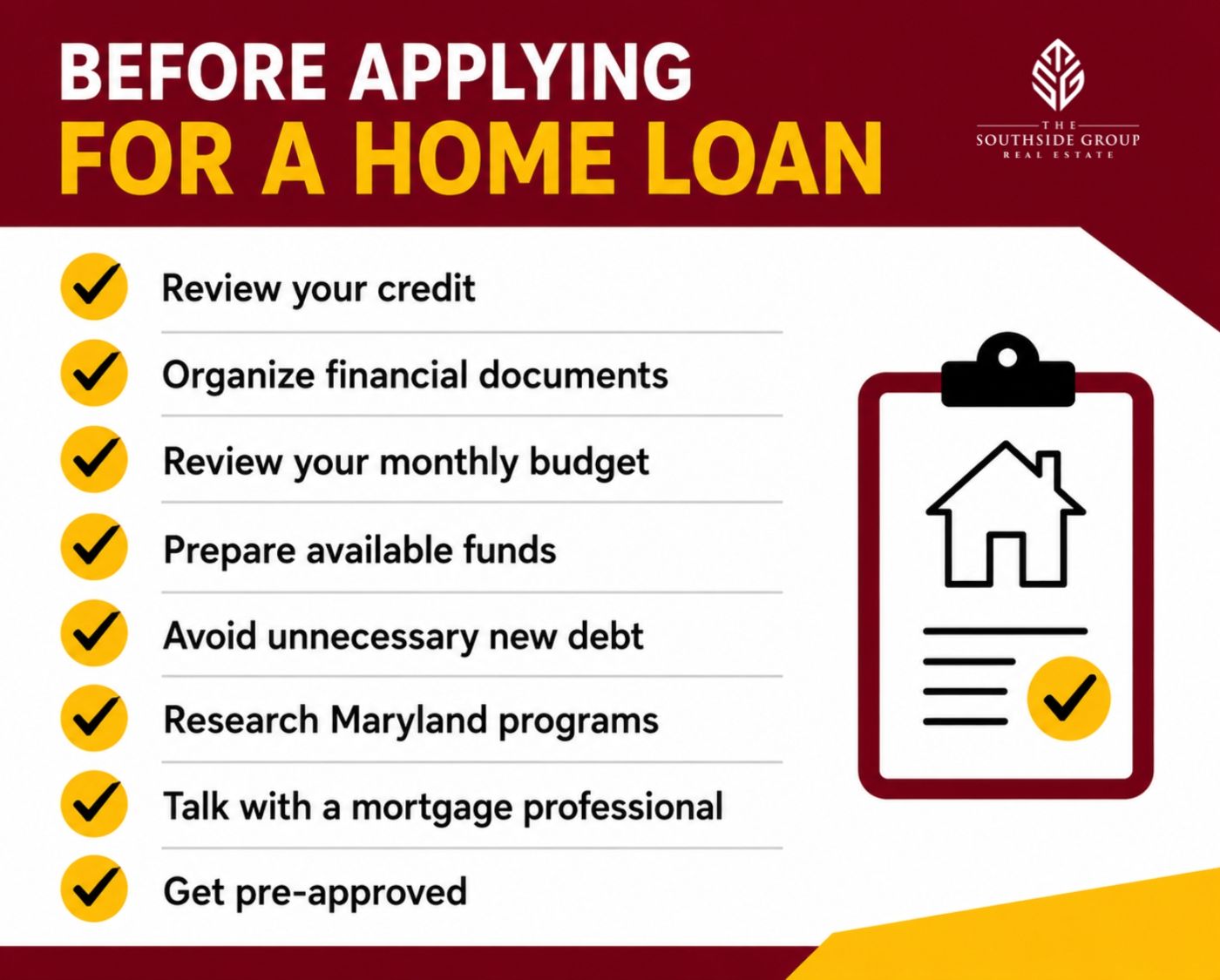
Before applying for a home loan, use this quick checklist:
Review your credit. Know what's on your reports and address potential inaccuracies.
Organize financial documents. Gather income, employment, bank, asset, and debt documentation.
Review your household budget. Decide what housing expense is comfortable for you—not simply what you might qualify to borrow.
Prepare available funds. Think beyond the down payment and consider other transaction and post-closing expenses.
Avoid unnecessary new debt. Talk with your lender before making major financial changes.
Research Maryland programs. Explore current Maryland Mortgage Program resources and eligibility requirements.
Complete homebuyer education when required or useful. Learn the process before you're under contract.
Talk with a mortgage professional. Ask which loan options may fit your circumstances.
Get pre-approved. Establish a clearer financing framework before seriously shopping.
Connect with a Southern Maryland real estate professional. Once you understand your financing, start building a home-search strategy around your goals.
Why Work With a Southern Maryland Real Estate Expert
Mortgage preparation is only one part of buying a home. Once you're financially prepared and have spoken with a lender, you'll need to turn that information into a practical home-search and offer strategy.
Working with a real estate professional who understands St. Mary's County, Charles County, and Calvert County can help you navigate the local market, evaluate available properties, prepare competitive offers, coordinate transaction deadlines, and understand what comes next after you're under contract.
Buyers searching for Top Real Estate Agents & Realtors should look beyond rankings or marketing claims and consider local market knowledge, responsiveness, transaction experience, communication, and the ability to guide clients through the full purchase process.
A trusted Southern Maryland real estate expert can also coordinate with your lender and other professionals involved in the transaction while helping you stay focused on the real estate decisions that matter.
Ready to Start Buying a Home in Southern Maryland?
Preparing before applying for a home loan can give you a stronger foundation for the buying process. Review your finances, organize your documents, understand your options, ask questions, and get pre-approved before you become deeply invested in a particular property.
Then it's time to put that preparation to work.
Whether you're buying your first home, relocating to the area, purchasing your next property, or exploring an investment, our team can help you navigate the Southern Maryland real estate market from your initial search through closing.
Start your Southern Maryland home search and explore our buyer resources:
https://marylandlistings.com/buy
This article provides general educational information and is not mortgage, financial, tax, or legal advice. Mortgage requirements, loan terms, program eligibility, and borrower qualifications vary. Consult an appropriate mortgage professional regarding your individual circumstances.