
Buying a home in Southern Maryland can involve some tough decisions, especially when a seller receives multiple offers. One question buyers often face is whether waiving contingencies will make their offer more attractive.
If you're researching St. Mary's County home contingencies, the most important thing to understand is that removing a contract protection can strengthen an offer, but it can also leave you responsible for expensive surprises.
That decision matters whether you're shopping in Lexington Park, exploring homes in Calvert County, or considering a property in Charles County.
In 2026, buyers should focus on more than getting an offer accepted. The goal is to purchase a home on terms that make sense financially, with a clear understanding of the risks involved.
What Are Real Estate Contingencies, and Why Do Buyers Need Them?
A real estate contingency is a condition written into a purchase contract that gives a buyer certain rights if a specified event occurs or a requirement is not satisfied.
For example, an inspection contingency may allow a buyer to request repairs, negotiate, or terminate the contract under certain circumstances, depending on the agreement's language.
Contingencies can address several major concerns:
-
The property's physical condition
-
Whether the home appraises for an acceptable amount
-
Whether the buyer can obtain financing
-
Whether the buyer must sell another property before completing the purchase
When a buyer waives a contingency, they give up some or all of the contractual protection associated with that condition.
That does not necessarily mean the buyer is prohibited from obtaining an inspection or that the lender will stop requiring an appraisal. It means the buyer's contractual options may become more limited.
An important distinction: The consequences of waiving a contingency depend on the specific Maryland contract and addenda. Buyers should understand those terms before signing, rather than assuming every contingency works the same way.
Four Common Contingencies Buyers Consider Waiving 
Not every contingency carries the same level of risk. Some involve the property's condition, while others affect the buyer's ability to complete the purchase.
1. Home Inspection Contingency
A home inspection contingency can provide an opportunity to evaluate the property's condition and exercise specific rights if problems are discovered.
Waiving that protection may make an offer more appealing to a seller who wants fewer opportunities for renegotiation.
However, a buyer could later discover problems involving the roof, foundation, electrical system, plumbing, HVAC equipment, or moisture intrusion.
Southern Maryland buyers should also pay attention to property-specific systems. Some homes use private wells and septic systems, and waterfront properties may present additional maintenance or environmental considerations.
A general home inspection may not cover every specialized concern. Buyers may need separate evaluations by appropriately qualified professionals.
Potential reward: Fewer inspection-related contract conditions.
Potential risk: Unexpected repairs and reduced ability to renegotiate or cancel based on property condition.
2. Appraisal Contingency
An appraisal contingency generally protects a buyer when the property's appraised value does not satisfy the conditions established in the purchase agreement.
Consider this hypothetical example:
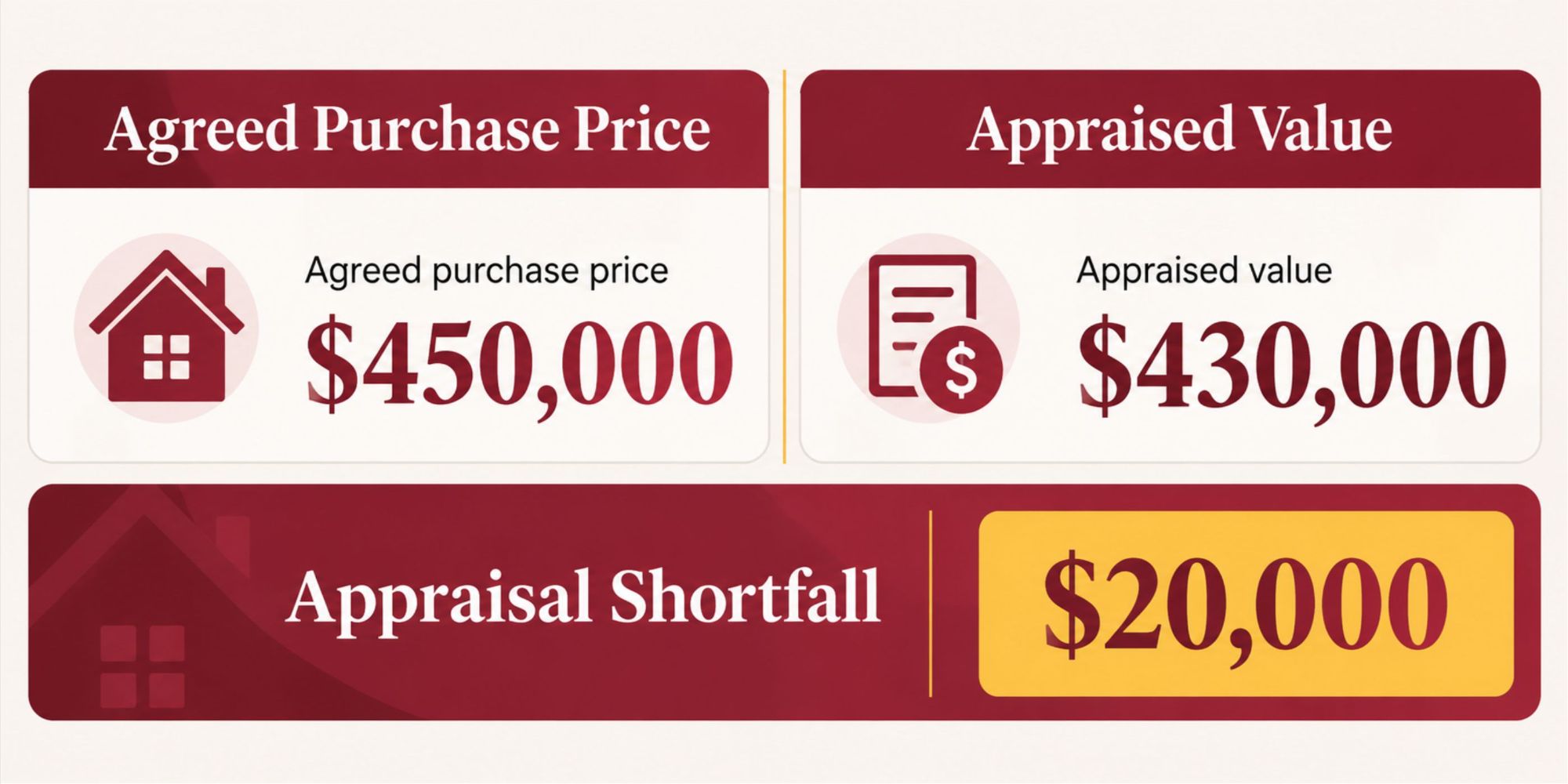
If a buyer agrees to cover an appraisal shortfall, they may need additional funds or another acceptable financing arrangement to close. The actual amount depends on the lender's requirements, loan structure, down payment, and contract terms.
Without an applicable appraisal protection, a buyer may have fewer options to terminate the agreement because of a low valuation.
3. Financing Contingency
A financing contingency can provide protection if the buyer cannot obtain the financing specified in the agreement, subject to the contract's requirements.
Even a buyer with mortgage pre-approval may encounter financing issues before closing.
Changes in employment, credit, debt, property eligibility, or underwriting requirements can affect the lender's final decision.
Waiving financing protection can be especially risky when the buyer needs mortgage financing to complete the transaction.
Before making an offer, buyers can review the mortgage pre-approval process and discuss their financial position with a qualified lender.
Pre-approval is helpful, but it is not a guarantee of final loan approval.
4. Home-Sale Contingency
A home-sale contingency may allow a buyer to make a purchase dependent on selling an existing property.
This can matter when the proceeds from the current home are needed for the next purchase.
Waiving the contingency may make the offer simpler for the seller, but the buyer must understand what happens if their existing property does not sell on schedule.
Potential consequences include carrying two housing payments, needing bridge financing, or being unable to complete the purchase.
Buyers considering this approach should review their available funds, financing options, and contractual obligations before making a commitment.
The Potential Rewards of Waiving Contingencies in 2026
Why would a buyer consider waiving protections that could save them money?
Because sellers evaluate more than the purchase price.
A seller may consider the likelihood of closing, the number of conditions attached to an offer, the proposed timeline, and the possibility of unexpected delays.
An offer with fewer contingencies may provide several potential advantages.
Greater certainty for the seller. Fewer contractual conditions can reduce some of the circumstances that might lead to termination or renegotiation.
A simpler transaction. An offer with fewer conditions may require fewer negotiations after acceptance.
A competitive advantage. When sellers are comparing otherwise similar offers, the terms and contingencies may influence which offer they prefer.
However, none of these benefits guarantees acceptance.
A seller might prefer a slightly lower offer with stronger financing, a workable closing date, and clearly documented funds.
Buyers should also remember that eliminating contingencies does not eliminate the underlying risks. It can transfer more of those risks to the buyer.
The Biggest Risks of Waiving Contingencies in Southern Maryland 
The consequences of a contingency waiver can extend well beyond the initial offer negotiation.
Unexpected Property Repairs
A property can look well maintained during a showing and still have expensive issues.
Older mechanical systems, hidden water damage, foundation concerns, or deferred maintenance may not be obvious without professional evaluation.
In Southern Maryland, certain properties also require additional due diligence.
For example, a home with a private septic system may warrant a specialized inspection. A property near the Chesapeake Bay or its tributaries may require closer review of flood exposure, drainage, and insurance considerations.
Earnest-Money Deposit Exposure
An earnest-money deposit demonstrates a buyer's commitment to the purchase.
Whether the deposit is refundable depends on the contract, applicable contingencies, deadlines, and circumstances of the transaction.
If a buyer waives a protection and later cannot close, the deposit may be at risk.
A dispute can also arise over who is entitled to the funds. Waiving a contingency does not automatically mean the seller receives the deposit, and the amount of potential liability is not necessarily limited to the deposit.
Buyers should have their agent explain the relevant contract provisions and seek Maryland legal advice when appropriate.
Appraisal and Financing Problems
A buyer might agree to purchase a home at a particular price, only to learn that the lender's appraisal or underwriting decision creates a problem.
If the contract no longer provides a relevant termination right, the buyer could face difficult choices involving additional cash, alternative financing, or possible contractual consequences.
The key question is not simply whether the buyer expects the transaction to close.
It is whether the buyer can manage the financial consequences if something goes wrong.
Should St. Mary's, Calvert, and Charles County Buyers Waive Contingencies?
Southern Maryland is not one uniform housing market.
Conditions can differ among St. Mary's, Calvert, and Charles counties. They can also vary by price range, property condition, location, and the number of competing homes available.
A well-maintained home receiving several offers may create a different negotiation environment than a property that has remained on the market for an extended period.
Buyers should evaluate the specific home rather than assume that every seller expects contingency waivers.
St. Mary's County
In St. Mary's County, buyers may consider homes in California, Hollywood, Leonardtown, Great Mills, and Lexington Park.
Properties can vary considerably in age, construction, acreage, and utility systems.
Buyers should evaluate inspection needs, financing requirements, and the property's specific condition before deciding whether to modify any protections.
Calvert County
Calvert County offers a range of residential properties, including homes near the Chesapeake Bay and Patuxent River.
Waterfront location, drainage, shoreline conditions, and potential flood exposure can make property-specific research especially important.
These considerations do not automatically make a property unsuitable, but they can affect the type of due diligence a buyer should complete.
Charles County
Charles County buyers may explore properties in Waldorf, La Plata, Indian Head, and surrounding communities.
Some purchases involve resale homes with established maintenance histories, while others involve newer construction.
The appropriate contingency strategy depends on the property's characteristics, the builder or seller's obligations, and the buyer's financing.
For current opportunities across all three counties, buyers can browse Southern Maryland homes for sale and compare individual properties.
The practical takeaway: Competition should be evaluated using current, property-specific information. Countywide trends alone cannot establish whether waiving contingencies is necessary for a particular offer.
What VA Loan Buyers Near NAS Patuxent River Should Know
Military buyers relocating to the NAS Patuxent River area may be especially concerned about submitting competitive offers while working within a PCS timeline.
VA financing introduces some important considerations.
A VA loan generally requires a VA appraisal that addresses valuation and applicable minimum property requirements. However, that appraisal is not a substitute for a comprehensive home inspection.
VA-financed purchase transactions also involve protections associated with the VA escape clause.
Under applicable VA requirements, the escape clause generally protects the buyer from being obligated to complete the purchase or forfeiting earnest money solely because the property's value, as established for VA purposes, is below the contract price.
That protection is not the same as a general right to cancel for any reason. Buyers should also understand the distinction between the VA escape clause and any separately negotiated appraisal contingency.
The official VA home-buying guidance explains the VA loan process and the role of the appraisal.
For buyers relocating near Patuxent River, useful preparation includes confirming financing requirements, arranging property evaluations, and discussing closing timelines early.
No buyer should assume that using a VA loan automatically prevents them from making a competitive offer.
How to Make a Strong Offer Without Waiving Every Contingency 
A competitive offer does not have to mean accepting every possible risk.
Buyers may be able to improve their terms in ways that preserve important protections.
Here are several strategies worth discussing with a Southern Maryland real estate professional:
1. Obtain thorough mortgage pre-approval. Work with a lender to review income, assets, credit, and financing requirements before submitting an offer.
2. Use realistic inspection timelines. When inspectors are available, a reasonable and clearly defined inspection period may help reduce uncertainty for the seller.
3. Document available funds. Appropriate proof of funds may help demonstrate the ability to complete the purchase, while protecting sensitive financial information.
4. Consider closing-date flexibility. If financing, moving arrangements, and the buyer's circumstances allow, a closing schedule that works for the seller may strengthen the offer.
5. Evaluate targeted contingency modifications. Instead of removing every protection, buyers can discuss carefully defined terms with their agent and, when needed, a Maryland real estate attorney.
6. Understand the full cost of ownership. Property taxes, insurance, repairs, maintenance, and possible specialized systems should be considered before stretching the budget.
Not every strategy will work for every transaction.
For example, a shorter inspection period is only useful if qualified inspectors can actually complete the necessary evaluations.
The strongest approach is one that balances seller priorities with the buyer's ability to complete the transaction.
A Smart Contingency Strategy Starts With the Property and Your Budget
Before waiving any contingency, buyers should understand both the potential benefit and the consequences.
Use this checklist during offer preparation:

If you cannot comfortably accept the consequences of a particular waiver, that is an important reason to reconsider the terms.
There is no universal rule that buyers should waive contingencies in 2026.
The right decision depends on the home, the contract, the buyer's financing, and the amount of risk they are prepared to accept.
A well-structured offer should give the seller confidence while helping the buyer make an informed purchase decision.
Important 2026 Maryland Legal Update
Maryland enacted Chapter 716, Senate Bill 691, effective October 1, 2026. The legislation changes provisions governing residential real estate contingency clauses and the distribution of trust money when qualifying contracts are terminated.
For buyers making offers late in 2026, this is an important reason to review current Maryland contract forms and earnest-money provisions. The legislation does not mean every canceled transaction automatically qualifies for a deposit refund.
Buyers can review the official Maryland contingency legislation and consult a Maryland real estate attorney for questions about how the law applies to a particular contract.
Frequently Asked Questions About Waiving Home Contingencies in Southern Maryland
Can I lose my earnest money if I waive a contingency in Maryland?
Yes, depending on the contract and the circumstances. If you cannot complete the purchase and do not have an applicable contractual or legal right to terminate, your earnest money may be at risk. Maryland's updated 2026 contingency law also affects certain deposit-return procedures. A contract-specific review is essential.
Can I still get a home inspection after waiving the inspection contingency?
Potentially, yes, if the contract and seller's agreed access terms permit it. However, having permission to inspect is different from having the contractual right to negotiate repairs or cancel based on the results. The Consumer Financial Protection Bureau recommends thorough home inspections.
Can a seller require me to waive contingencies?
A seller can generally propose contract terms and decide whether to accept an offer, subject to applicable laws. Buyers do not have to agree to every requested waiver. They can negotiate alternative terms or decide not to proceed.
Can VA loan buyers waive appraisal protections?
VA buyers must account for the required VA escape clause in applicable purchase contracts. The clause provides specific protection when VA's established reasonable value is below the contract price. It is not the same as a general appraisal contingency and cannot simply be eliminated when VA requires it.
Is waiving contingencies necessary to win a home in Southern Maryland in 2026?
No. Sellers may also consider financing strength, closing timelines, documentation, and other contract terms. The appropriate approach depends on the specific property and competing offers. Waiving contingencies is one possible negotiating strategy, not a universal requirement.
Buying a Home in Southern Maryland? Build an Offer That Makes Sense.
Whether you're purchasing your first home, relocating to NAS Patuxent River, or moving within St. Mary's, Calvert, or Charles County, understanding your contract protections is an important part of buying confidently.
The Southside Group Real Estate can help you evaluate property-specific considerations, discuss offer strategies, and coordinate with your lender or other qualified professionals.
Contact The Southside Group Real Estate to discuss your Southern Maryland home search and how to approach your next offer.
This article is for general educational purposes and is not individualized legal, lending, or financial advice. Contract terms and legal rights vary by transaction.
FROM OUR BLOG

Buying a Home in Southern Maryland: Ultimate Guide
Buying a home in Southern Maryland is an exciting opportunity, whether you're purchasing your first property, relocating for work, or looking for a home that better fits your lifestyle. With waterfront communities, established neighborhoods, rural properties, and convenient access to major employmen

How Military Relocations Affect the Southern Maryland Real Estate Market
Military relocations are an important part of the Southern Maryland housing market. With Naval Air Station Patuxent River, Naval Support Facility Indian Head, and a substantial defense-related workforce throughout the region, military assignments and employment changes influence how people buy, sell

Black Friday Home Upgrades for Southern Maryland Sellers
Black Friday is usually associated with holiday shopping, but it can also be an opportunity for homeowners planning to sell their properties. From fresh paint and updated lighting to cleaning equipment and storage solutions, seasonal home improvement deals can help sellers purchase practical supplie