
A real estate agent's calendar can fill up quickly. Between client calls, property showings, contract deadlines, marketing, prospecting, and paperwork, it's easy to finish a busy day wondering what actually moved your business forward.
The challenge isn't necessarily a lack of effort. It's how that effort is distributed.
Improving real estate agent productivity means identifying which activities require your expertise, which can be handled by technology, and which can be assigned to someone else.
The goal isn't to remove the personal side of real estate. It's to protect it.
Whether you're a newer agent establishing routines or an experienced agent managing multiple transactions, a thoughtful approach to automation, delegation, and time management can help you create a more organized business.
Start With a Real Estate Agent Time Audit 
Before purchasing new software or hiring administrative help, find out where your time actually goes.
A time audit is a simple process of tracking your daily activities to understand how much time you spend on different responsibilities.
For five business days, record what you're doing and approximately how long each activity takes.
Separate your work into five categories:
-
Client-facing activities: Consultations, showings, negotiations, and direct client communication.
-
Business development: Prospecting, networking, relationship building, and personal follow-up.
-
Administrative work: Data entry, scheduling, filing, and document organization.
-
Marketing: Content creation, listing promotion, and campaign preparation.
-
Transaction management: Deadline tracking, paperwork coordination, and communication with transaction participants.
At the end of the week, look for recurring activities that consume time without consistently requiring your personal involvement.
Real Estate Agent Time Audit Worksheet
Use this worksheet to evaluate your workload. The sample entries are illustrative, not industry averages.
|
Activity |
Time per occurrence |
Five-day frequency |
Decision |
|---|---|---|---|
|
CRM contact updates |
20 min |
5 |
Automate |
|
Appointment scheduling |
15 min |
8 |
Automate |
|
Document organization |
30 min |
4 |
Delegate |
|
Buyer consultations |
60 min |
3 |
Keep |
|
Contract negotiations |
45 min |
2 |
Keep |
|
Marketing formatting |
40 min |
2 |
Delegate |
To calculate the time spent on an activity, multiply the minutes per occurrence by the number of occurrences during the audit period.
Then ask yourself:
-
Does this activity require my license, professional judgment, or direct relationship with a client?
-
Is it repetitive and governed by a predictable process?
-
Could a qualified person complete it with clear instructions and appropriate supervision?
-
Would changing this activity create meaningful time for higher-priority work?
Don't automatically eliminate tasks because they're administrative. Some are essential for compliance, client service, and accurate records.
Instead, identify how they can be completed more efficiently.
What Real Estate Agents Should Automate
Automation works best for predictable, repetitive tasks that follow established rules.
The purpose of real estate CRM automation isn't to replace personal communication. It's to reduce the manual steps surrounding it.
1. CRM Follow-Up Reminders 
Your CRM should help you remember when to reconnect with contacts.
For example, after a buyer consultation, you might create a workflow that schedules a follow-up task, reminds you to send requested information, and prompts a later personal check-in.
This reduces the chance of forgetting an important conversation.
Use contact preferences and consent requirements when configuring automated messages. Sensitive conversations should remain personal.
2. Appointment Scheduling and Confirmations
Scheduling can involve multiple emails or phone calls.
Calendar scheduling tools can reduce back-and-forth communication by displaying available appointment windows and generating confirmations.
Consider adding appropriate reminders before consultations and meetings.
Always account for travel time, property access requirements, and changes to the appointment.
3. Email Templates and Reusable Responses
Many client communications follow similar patterns.
Create templates for common situations, such as:
-
Buyer consultation confirmations
-
Seller onboarding information
-
Document requests
-
Inspection scheduling
-
Transaction milestone updates
A template provides structure, but it shouldn't become a substitute for reviewing the client's actual situation.
Check names, dates, property details, and transaction-specific information before sending.
4. Transaction Milestone Reminders
Real estate transactions involve deadlines that require attention.
A transaction checklist or workflow can help track important dates, assigned responsibilities, and outstanding documents.
Automated reminders can support that process, but agents and their supervising brokers must still ensure that deadlines and contractual obligations are handled correctly.
5. Marketing and Content Workflows
Not every marketing task needs to start from scratch.
Reusable layouts, content calendars, approved descriptions, and standardized production checklists can simplify marketing preparation.
For example, an agent could develop a repeatable checklist for preparing a new listing announcement.
Before publishing, review property information, brokerage identification, images, and advertising compliance.
Practical tip: Start with one automation that addresses a recurring problem. Test it before adding more workflows.
What to Delegate: Administrative Tasks and Transaction Coordination
Delegation becomes useful when tasks require human attention but not necessarily your direct involvement.
This may include administrative support, marketing assistance, or transaction coordination.
Administrative Tasks
Depending on applicable law, brokerage policy, and the worker's qualifications, administrative assistance may include:
-
Organizing transaction files
-
Maintaining calendars
-
Preparing documents for agent review
-
Updating approved CRM records
-
Coordinating routine administrative communications
-
Formatting marketing materials
Create clear instructions before assigning a task.
A useful delegation process identifies the expected result, required information, deadline, approval requirements, and person responsible for checking the work.
Transaction Coordination
A transaction coordinator may assist with administrative aspects of a transaction, including file organization, checklist maintenance, scheduling, and deadline reminders.
The exact responsibilities depend on licensing rules, brokerage policies, and the coordinator's role.
Delegating transaction administration does not transfer the agent's professional responsibilities or eliminate the supervising broker's obligations.
Before hiring a coordinator, ask:
-
Which services are included?
-
How are deadlines monitored?
-
Who communicates with clients and other transaction participants?
-
What happens when an issue requires licensed judgment?
-
How are client records protected?
-
Who reviews completed work?
Understand Delegation Boundaries in Maryland
Maryland real estate agents should distinguish administrative assistance from activities that require a real estate license.
The Maryland Real Estate Commission provides guidance concerning permissible activities of unlicensed assistants. Agents should review that guidance before assigning duties involving property showings, contract explanations, negotiations, or other licensed services.
Consult the Maryland Real Estate Commission and your supervising broker when defining responsibilities.
A useful rule is to delegate administrative execution when permitted, while retaining licensed judgment, required supervision, and accountability.
What Real Estate Agents Should Keep
Some responsibilities should remain central to the agent's role, even when support systems are available.
Client Relationships 
Clients benefit from knowing who is responsible for guiding them through major decisions.
Personal conversations help agents understand changing priorities, concerns, and expectations.
Automation can schedule a conversation. It cannot fully replace the professional relationship developed during that conversation.
Negotiations and Professional Advice
Negotiations, pricing recommendations, and contract-related guidance require professional judgment and attention to the specific transaction.
These activities should be handled by appropriately licensed professionals within the scope of their authority.
Sensitive Conversations
Inspection concerns, financing complications, unexpected delays, and difficult decisions deserve thoughtful communication.
A generic automated message may create confusion when a client needs an explanation tailored to their circumstances.
Business Development Relationships
Prospecting can be supported by CRM reminders and marketing workflows, but meaningful relationship building still requires personal involvement.
Protect time for conversations with past clients, professional contacts, and prospective clients.
The principle is simple: Automate the reminder, delegate the permitted preparation, and keep the relationship.
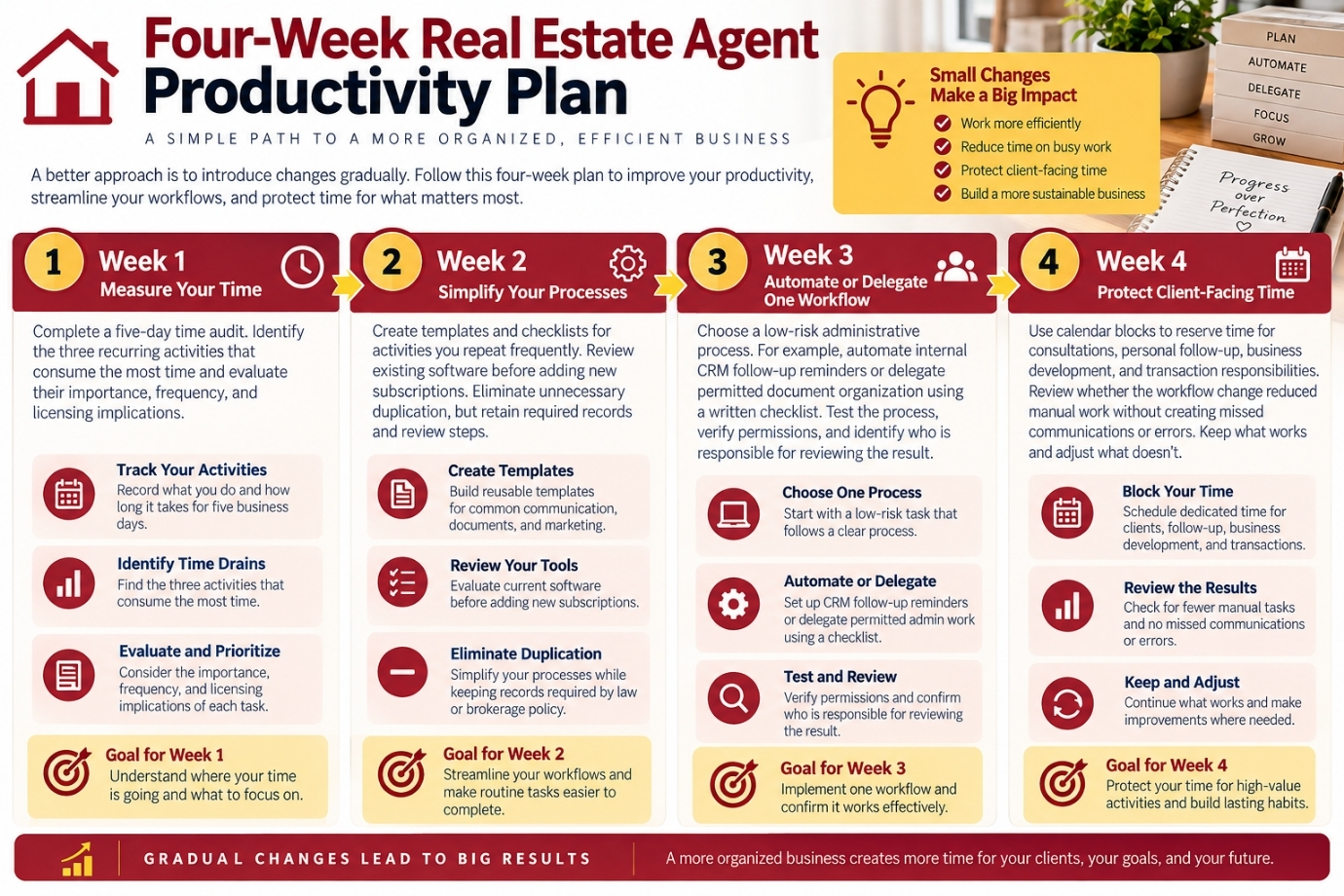
Common Productivity Mistakes and a 30-Day Improvement Plan
Productivity improvements can create new problems when implemented without a clear process.
Common mistakes include automating communication that requires personal attention, delegating without written instructions, adding too many disconnected tools, failing to review completed work, and allowing administrative tasks to consume time reserved for clients.
How Brokerage Systems and Support Can Improve Agent Productivity
Productivity isn't only about individual discipline. The professional environment in which an agent works can influence how efficiently tasks are completed.
When evaluating a brokerage, consider the systems and resources available to support daily operations.
Useful questions include:
-
Is there a clear process for managing transactions and documents?
-
What CRM tools or integrations are available?
-
How are agents trained to use the systems?
-
What administrative or transaction coordination options exist?
-
Who can answer questions about compliance and delegation?
-
Are expectations for agent responsibilities clearly communicated?
A brokerage's technology offerings should be evaluated alongside training, supervision, workflow clarity, and the actual cost of available services.
Agents considering a brokerage change should ask for specific explanations and demonstrations rather than assuming that a particular system will automatically improve productivity.
The right environment for one agent may not be the right environment for another.
FAQs About Real Estate Agent Productivity: Automate, Delegate, Keep
What tasks should real estate agents automate first?
Start with predictable administrative activities such as internal follow-up reminders, scheduling confirmations, reusable templates, and transaction checklist notifications. Choose processes that can be tested and reviewed easily.
When should a real estate agent hire a transaction coordinator?
Consider transaction coordination when administrative transaction work regularly competes with client-facing responsibilities. Evaluate transaction volume, costs, service scope, brokerage requirements, and applicable licensing rules before hiring.
What can an unlicensed real estate assistant legally do in Maryland?
Unlicensed assistants may perform certain administrative duties, but they cannot independently perform activities that require a real estate license. Agents should consult current Maryland Real Estate Commission guidance and their supervising broker before assigning responsibilities.
How can agents spend less time on paperwork and more time with clients?
Start with a time audit, standardize document workflows, use approved digital tools, and delegate permitted administrative tasks. Maintain required reviews and protect scheduled time for client communication.
Build a Business That Protects Your Time
Improving real estate agent productivity doesn't mean filling every available hour with more activity.
It means becoming more intentional about how you spend your time.
Start by understanding your workload. Automate predictable processes, delegate appropriate administrative responsibilities, and preserve the work that requires your expertise and relationships.
Small, carefully managed changes can create a more organized daily routine while maintaining professional standards.
As you evaluate your systems, it's also worth considering whether your brokerage environment supports the way you want to work.
Grow Your Real Estate Career With the Right Support
Building a successful real estate business takes more than hard work. The right training, tools, guidance, and professional environment can help agents develop stronger systems and grow with confidence.
Interested in learning more about The Southside Group Real Estate?
FROM OUR BLOG


Charles County MD Events This Weekend | October 22–25, 2026
Charles County MD events this weekend are bringing Halloween thrills, fall festivals, trick-or-treating, and plenty of community fun to Southern Maryland from Thursday, October 22, through Sunday, October 25, 2026! If you've been searching for "Halloween events near me," "free things to do in Charle

Who Is Considered a First-Time Home Buyer in Maryland?
First-time home buyer Maryland rules may be more flexible than you think. You do not necessarily have to be buying your first house ever to qualify as a first-time homebuyer under certain Maryland programs. For the Maryland Mortgage Program (MMP), Maryland currently defines a first-time homebuyer as

St. Mary's County Events This Weekend | October 22–25, 2026
St. Mary's County events this weekend are bringing Halloween excitement, historic adventures, creative workshops, and seasonal community gatherings to Southern Maryland from October 22–25, 2026! Looking for fun things to do near you? From haunted attractions in Avenue and waterfront festivities in L