
A low home appraisal in Southern Maryland can create an unexpected challenge when buying or selling a home. You have negotiated a purchase price, signed the contract, and started preparing for closing. Then the appraisal comes back below the agreed-upon price.
Does that mean the deal is over? Not necessarily.
A low appraisal can affect how much a mortgage lender is willing to finance, but buyers and sellers often have several options. Depending on the contract, financing, and circumstances, they may be able to renegotiate the price, address the difference in value, request an appraisal review, or reconsider the transaction.
Whether you are buying in St. Mary's County, selling in Calvert County, or negotiating a home purchase in Charles County, understanding the appraisal process can help you make a more informed decision.
What Does It Mean When a Home Appraisal Comes in Low?
A home appraisal is an independent opinion of a property's market value prepared by a qualified appraiser. Mortgage lenders generally use appraisals to help evaluate the property serving as collateral for a loan.
A low appraisal occurs when the appraiser's opinion of value is less than the purchase price stated in the contract.
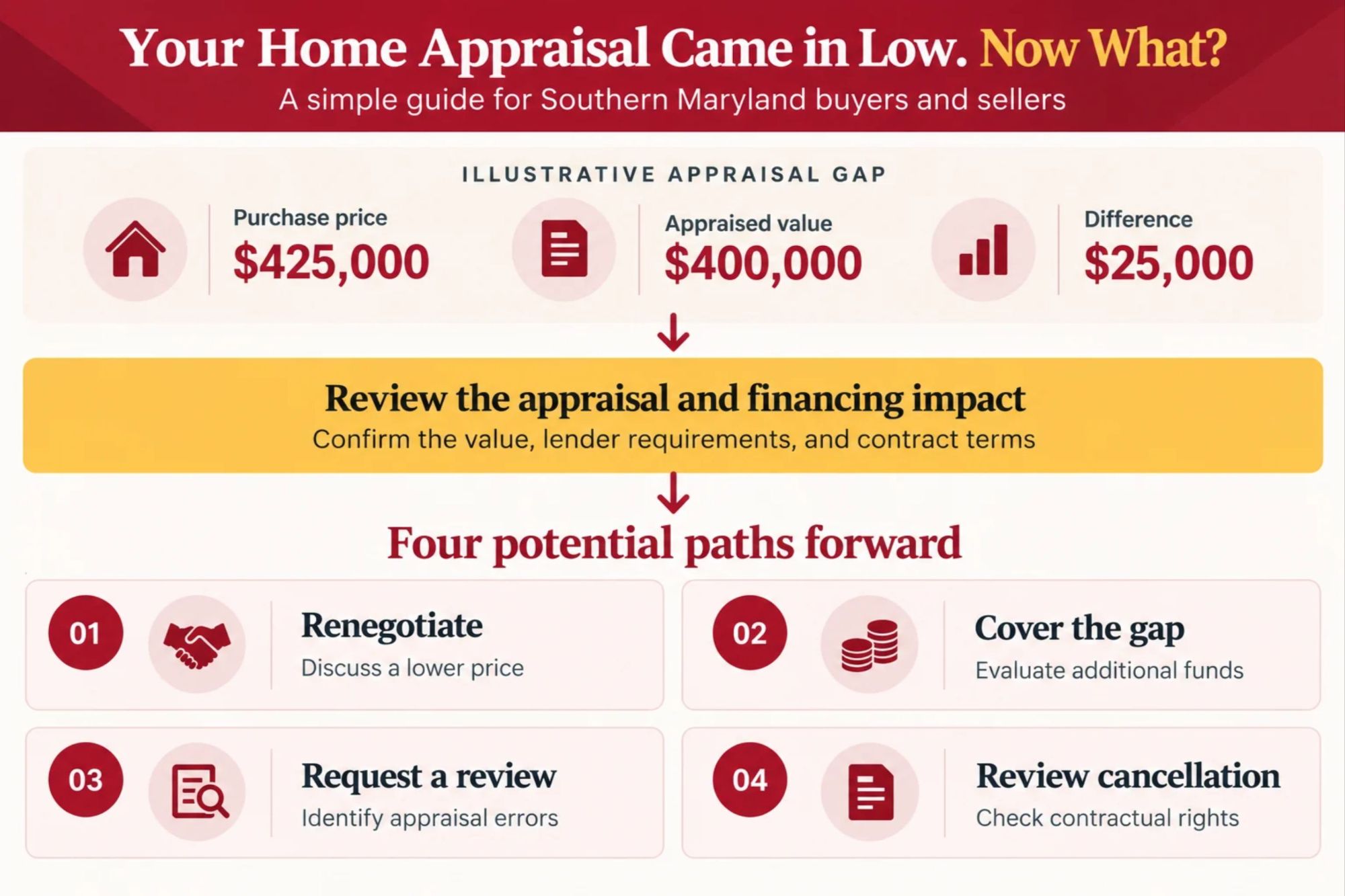
For example, a buyer and seller might agree on a $425,000 purchase price, but the appraisal determines the property's value is $400,000.
That creates a $25,000 difference, commonly called an appraisal gap.
An appraisal is different from a home inspection. A home inspection focuses on the property's condition and potential defects, while an appraisal estimates market value. Although property condition can influence value, the two services serve different purposes.
It is also important to understand that an appraisal does not automatically determine what a buyer must pay. The purchase contract establishes the agreed-upon price unless the parties negotiate a change or the contract otherwise permits a different outcome.
Why Do Home Appraisals Come in Low in Southern Maryland? 
Several factors can contribute to an appraisal coming in below the contract price.
Comparable Home Sales
Appraisers typically evaluate recent sales of properties with similar characteristics, making adjustments for relevant differences.
In Southern Maryland, finding suitable comparable properties can be challenging when homes vary significantly in acreage, age, condition, or features.
For example, a property with several acres in Mechanicsville may require different comparable sales than a home in a subdivision in Waldorf.
Property Condition and Improvements
An appraiser considers the property's condition, quality, and relevant improvements.
A renovated kitchen, finished basement, detached garage, or other upgrade may influence value. However, the amount spent on improvements does not necessarily equal the increase in appraised value.
Unique Property Features
Southern Maryland includes waterfront properties, rural homes, established subdivisions, and properties with substantial land.
Unusual features can complicate the valuation process when few recently sold properties offer meaningful comparisons.
For instance, evaluating a waterfront property in Lusby may involve considerations that differ from those for a conventional subdivision home in California, Maryland.
The Contract Price Exceeds Supported Market Value
Buyers sometimes agree to prices above what recent comparable sales support.
That can happen when a property attracts strong interest, when buyers place additional value on specific features, or when the available comparable sales do not fully reflect the property's appeal.
A low appraisal does not necessarily mean either party acted improperly. It means the appraiser's supported opinion of value differs from the agreed purchase price.
How Does a Low Appraisal Affect Your Mortgage?
For many mortgage transactions, lenders use the appraised value when calculating the loan-to-value ratio.
When the appraisal is lower than the contract price, the lender may calculate the maximum available financing using the lower appraised value.
Consider this hypothetical example:
|
Item |
Amount |
|---|---|
|
Agreed purchase price |
$425,000 |
|
Appraised value |
$400,000 |
|
Appraisal gap |
$25,000 |
|
Illustrative maximum loan at 80% loan-to-value |
$320,000 |
If the lender permits an 80% loan-to-value ratio, the maximum loan in this simplified example would be $320,000.
At the original purchase price, the buyer would need $105,000 toward the purchase price, excluding closing costs and other expenses.
If the property had appraised at $425,000, an 80% loan would have been $340,000, requiring $85,000 toward the purchase price.
That means the low appraisal increases the buyer's required contribution by $20,000 in this particular scenario, assuming the price remains unchanged and the loan terms otherwise stay the same.
The appraisal gap and the additional cash required are not always the same amount.
The actual impact depends on the loan program, down payment, lender requirements, mortgage insurance, and any agreement between the buyer and seller.
Buyers should review the updated financing figures with their lender before committing additional funds.
For those preparing to purchase, understanding mortgage pre-approval can also help establish a realistic financing plan before making an offer.
What Are Your Options If the Appraisal Comes in Low? 
A low appraisal does not automatically end a real estate transaction. Buyers and sellers may have several possible paths forward.
1. Negotiate a Lower Purchase Price
One option is for the buyer to ask the seller to reduce the contract price.
Using the earlier example, the buyer might request a reduction from $425,000 to $400,000.
The seller is not automatically required to agree. However, a price adjustment may allow the transaction to continue without the buyer contributing as much additional cash.
The parties might also negotiate a price between the original contract amount and the appraised value.
2. Cover Some or All of the Appraisal Gap
If the buyer has sufficient available funds, they may choose to contribute additional cash.
For example, the seller might agree to reduce the price by $10,000 while the buyer accepts the remaining $15,000 difference between the revised price and appraised value.
Before making this decision, buyers should consider whether the additional contribution would affect their emergency savings, planned repairs, or other financial priorities.
The lender must also confirm that the revised financing arrangement meets its requirements.
3. Request a Reconsideration of Value
An appraisal may contain incorrect property details, overlook relevant comparable sales, or include other issues that warrant review.
A borrower can ask the lender about submitting a reconsideration of value, often called an ROV.
Potential supporting information might include:
-
Incorrect square footage or property characteristics.
-
Relevant comparable sales that were not considered.
-
Documented improvements or features that were overlooked.
-
Factual errors in the appraisal report.
The lender generally manages the formal review process. A reconsideration does not guarantee that the appraised value will change.
Fannie Mae provides guidance on the reconsideration-of-value process, including how borrowers can raise concerns about appraisal accuracy.
4. Consider Contractual Cancellation Options
If the buyer cannot obtain acceptable financing or the parties cannot resolve the valuation difference, cancellation may be an option.
However, the ability to cancel without losing a deposit depends on the specific contract, applicable contingencies, required notices, and deadlines.
Buyers should review these provisions with their real estate agent and obtain legal advice when necessary before making a final decision.
Can You Walk Away From a Low Appraisal in Maryland? 
Possibly, but a low appraisal does not automatically give a Maryland buyer the right to terminate a purchase agreement or recover an earnest money deposit.
The contract controls many of the parties' rights and responsibilities.
An appraisal contingency may provide certain protections when the property does not appraise at the required amount. A financing contingency may also be relevant if the low valuation affects the buyer's ability to obtain the agreed financing.
The precise protections depend on the language of the signed agreement.
Important questions include:
-
Does the contract contain an appraisal contingency?
-
Is there a financing contingency that applies?
-
Did the buyer agree to cover a specified appraisal gap?
-
What notice and response deadlines apply?
-
What happens to the earnest money deposit if the transaction is terminated?
Buyers should not assume that an appraisal contingency and a financing contingency provide identical protections.
Likewise, removing or waiving a contingency can create financial exposure if the transaction cannot close as expected.
Because contract language and circumstances vary, a qualified Maryland real estate attorney should address specific legal questions.
What Should Southern Maryland Home Sellers Do After a Low Appraisal?
A low appraisal can be frustrating for sellers, particularly when they have already made plans based on the agreed purchase price.
Before deciding how to respond, it helps to evaluate the available information.
Review the appraisal and comparable sales. Ask whether the report accurately reflects the property's characteristics and whether relevant recent sales support a different valuation.
Understand the buyer's financing position. A buyer may have the resources to cover part of the gap, or the lender may have financing limitations that make the original price difficult to maintain.
Consider the cost of returning to the market. Rejecting a price adjustment may mean finding another buyer, extending the selling timeline, and potentially facing another appraisal.
Evaluate the entire transaction. Closing timing, financing terms, contract contingencies, and the buyer's ability to perform may matter alongside the purchase price.
For sellers in communities such as Leonardtown, Prince Frederick, and La Plata, a useful starting point is reviewing relevant local comparable sales rather than relying solely on the original asking price.
A home valuation can help begin a broader pricing discussion, although an online estimate is not a substitute for a professional appraisal.
The right response depends on the property's circumstances and the seller's priorities. A low appraisal is a reason to evaluate the transaction, not necessarily to abandon it.
How Can Buyers and Sellers Reduce Appraisal Problems?
No preparation can guarantee a particular appraisal result, but thoughtful planning can reduce avoidable surprises.
For Homebuyers
Before submitting an offer, review recent comparable sales and discuss the proposed price with your real estate agent.
Understand how your financing works if the appraised value is lower than expected.
If your offer includes an appraisal-gap provision, know exactly what you are agreeing to contribute and how that obligation interacts with your available funds.
Buyers comparing properties can also browse Southern Maryland homes for sale to become more familiar with available property types and asking prices. Remember that asking prices are not the same as verified closed-sale values.
For Home Sellers
Start with a pricing strategy supported by relevant market evidence.
Maintain accurate information about the property's features, condition, and improvements.
Keep records of major renovations and permitted work when available. These details may help an appraiser understand the property, although improvements do not guarantee an increase in value.
When reviewing offers, consider financing and appraisal-related terms in addition to the proposed purchase price.
A well-prepared transaction cannot eliminate every appraisal concern, but it can help buyers and sellers respond more effectively if one arises.
Frequently Asked Questions About Low Home Appraisals
Does a low appraisal automatically cancel a home sale?
No. A low appraisal may require the buyer and seller to renegotiate or adjust financing, but it does not automatically cancel the contract. The outcome depends on the parties' agreement, financing, and applicable contingencies.
Can a seller refuse to lower the price after a low appraisal?
Yes, a seller generally does not have to voluntarily accept a lower price simply because the appraisal came in below the contract amount. However, the seller's contractual obligations still apply, and the buyer may have rights under applicable contingencies.
Can a home appraisal be challenged?
Yes. Borrowers can ask their lender about a reconsideration of value when they identify potential errors, missing information, or relevant comparable sales. The review may or may not result in a changed value.
Do VA loans handle low appraisals differently?
VA-backed purchase loans have specific appraisal procedures, including the Tidewater process and reconsideration-of-value options. A VA appraisal also involves minimum property requirements. Buyers should consult their lender and current VA home loan appraisal guidance to understand the applicable process and contract protections.
Who pays for a second home appraisal?
Payment depends on the loan program, lender policies, reason for the additional appraisal, and applicable agreements. A second appraisal is not automatically available simply because someone disagrees with the first result. Ask the lender whether another appraisal is permitted and who would be responsible for the cost.
Navigating a Low Home Appraisal in Southern Maryland
A low appraisal can change the financial details of a real estate transaction, but it does not always prevent a successful closing.
The most useful next step is to understand the appraisal, confirm the financing impact, review the contract, and determine which options are realistically available.
If you are buying or selling in St. Mary's, Calvert, or Charles County and have questions about an appraisal issue, The Southside Group Real Estate can help you review the real estate considerations and discuss potential next steps.
Contact The Southside Group Real Estate to discuss your Southern Maryland home purchase or sale.
FROM OUR BLOG


Buying a Home in Southern Maryland: Ultimate Guide
Buying a home in Southern Maryland is an exciting opportunity, whether you're purchasing your first property, relocating for work, or looking for a home that better fits your lifestyle. With waterfront communities, established neighborhoods, rural properties, and convenient access to major employmen

How Military Relocations Affect the Southern Maryland Real Estate Market
Military relocations are an important part of the Southern Maryland housing market. With Naval Air Station Patuxent River, Naval Support Facility Indian Head, and a substantial defense-related workforce throughout the region, military assignments and employment changes influence how people buy, sell

Black Friday Home Upgrades for Southern Maryland Sellers
Black Friday is usually associated with holiday shopping, but it can also be an opportunity for homeowners planning to sell their properties. From fresh paint and updated lighting to cleaning equipment and storage solutions, seasonal home improvement deals can help sellers purchase practical supplie