
Many real estate agents spend a significant amount of time searching for new leads, exploring marketing strategies, and finding ways to grow their businesses. But what if some of your next opportunities are already sitting in your phone, email contacts, or CRM?
Your real estate database is more than a list of names and phone numbers. It's a collection of relationships you've built over time, including past clients, friends, family members, professional connections, and people who have expressed interest in buying or selling a home.
The challenge is that many agents collect contacts but struggle to maintain consistent communication. Some records are outdated, others haven't received a follow-up in months, and sometimes agents simply don't know what to say without sounding pushy.
Generating business from your real estate database starts with organization, meaningful conversations, and a consistent relationship-building routine.
In this guide, we'll cover practical strategies to clean up your database, reconnect with past clients, strengthen your sphere of influence, and create opportunities for future business. You'll also find a database audit worksheet you can use immediately.
Why Your Real Estate Database Is a Valuable Business Resource
Real estate is a relationship-driven business. While online advertising, open houses, and digital marketing can help agents meet new prospects, an existing database contains people who may already know and trust them.
These relationships can create opportunities beyond immediate transactions.
For example, a past client may not be thinking about selling today, but they might know someone preparing to relocate. A friend may have questions about buying their first home. A former buyer might want to understand their property's current value.
The goal isn't to turn every conversation into a sales opportunity. It's to remain a knowledgeable and approachable resource when someone needs real estate guidance.
Your Database Includes More Than Buyers and Sellers
A real estate database may include:
‣ Past buyers and sellers
‣ Friends, family members, and neighbors
‣ Former coworkers and professional acquaintances
‣ Active buyers and potential sellers
‣ Long-term real estate prospects
‣ Local business owners and community connections
‣ Professional referral partners
Each group represents an opportunity to maintain relationships, provide value, and stay connected.
The size of your database matters less than how consistently and thoughtfully you maintain those relationships.
Step 1: Clean Up and Organize Your Real Estate Database
Before you can generate business from your database, you need to know who's in it.
Over time, contact lists become cluttered with duplicate records, outdated phone numbers, incomplete information, and contacts who haven't been categorized.
Without organization, even a good follow-up strategy can become difficult to manage.
Start by reviewing your CRM, phone contacts, email lists, and other places where you store contact information.
What Information Should Every Contact Record Include?
Whenever possible, maintain the following information:
✔ First and last name
✔ Phone number and email address
✔ Preferred communication method
✔ Relationship category or CRM tag
✔ Relevant real estate interests or timeline
✔ Date of last meaningful conversation
✔ Next planned follow-up date
You don't need every detail immediately. Begin with the information you already have and update records as you reconnect with people.
Remove Duplicate and Outdated Contacts
If the same person appears multiple times in your database, review those records and combine them when appropriate.
For example, a past client might appear once under their email address and again under their phone number.
Before merging records, verify that they belong to the same person. Preserve important notes, communication history, and contact preferences.
This simple cleanup process helps reduce confusion and prevents repetitive follow-ups.
Step 2: Segment Your Contacts for More Relevant Follow-Up
Not everyone in your database needs the same type of communication.
A first-time homebuyer researching mortgage options has different needs from a homeowner who purchased five years ago.
That's why database segmentation matters.
Database segmentation means organizing contacts into groups based on their relationship with you, their real estate interests, and their communication needs.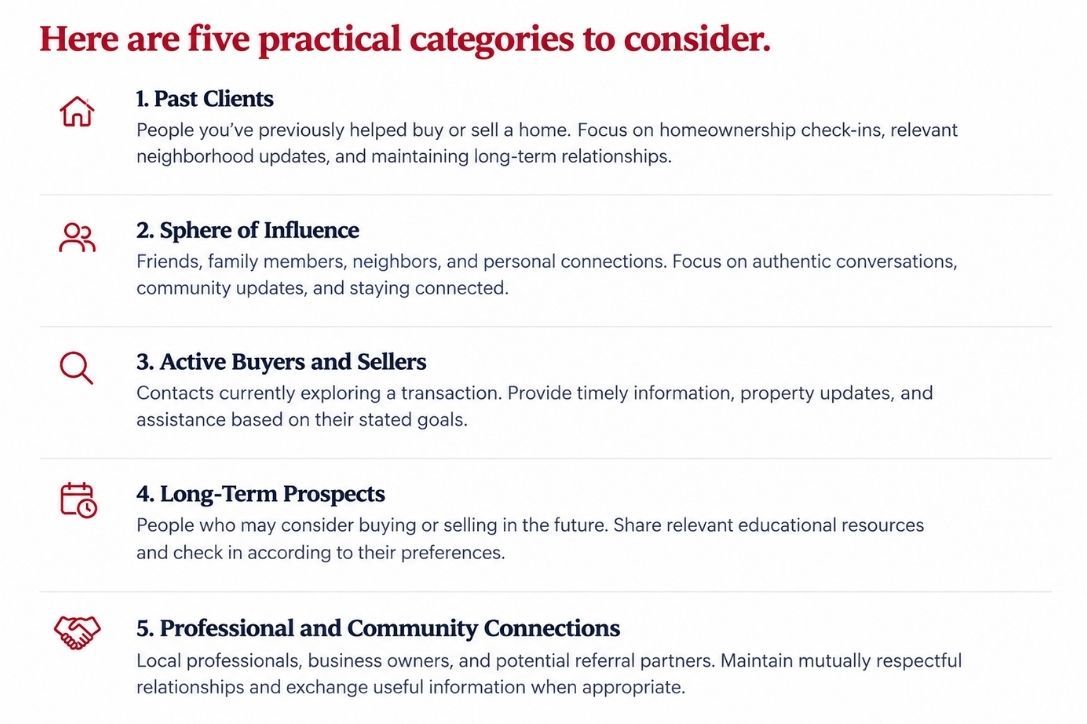
Once your contacts are organized into categories, you can create follow-up activities that make sense for each group.
Step 3: Reconnect With Past Clients Without Being Pushy 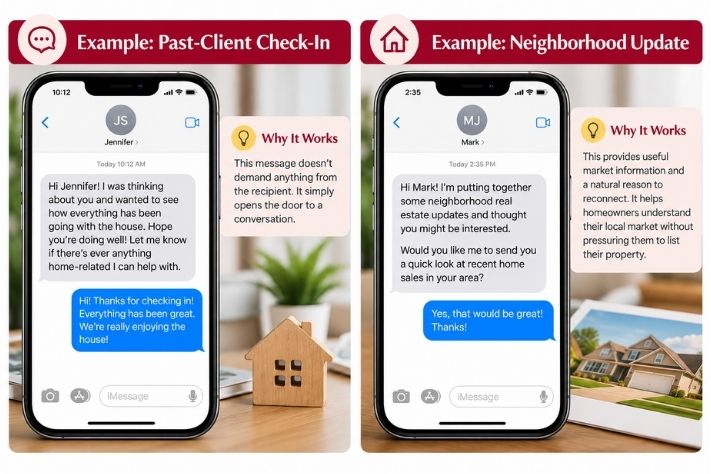
One of the most common missed opportunities in real estate is losing touch with clients after closing.
You've already helped these individuals through an important financial and personal decision. Maintaining that relationship allows you to continue providing value beyond the transaction.
But past-client follow-up shouldn't feel like a constant request for referrals.
Instead, focus on thoughtful conversations.
Simple Ways to Stay Connected With Past Clients
Consider reaching out when:
✔ They're approaching their home purchase anniversary.
✔ You have useful home maintenance information.
✔ They've expressed interest in neighborhood property values.
✔ You discover a community resource relevant to their interests.
✔ You simply want to see how they're enjoying their home.
Only offer market information you can support with accurate, current data.
The objective is to help homeowners understand their local market, not pressure them into listing their property.
Step 4: Strengthen Your Sphere of Influence Through Meaningful Conversations
Your sphere of influence includes people who know you through personal, professional, or community relationships.
These connections may include friends, relatives, neighbors, former coworkers, and people you've met through local activities.
Sphere-of-influence marketing works best when it feels like relationship-building rather than prospecting.
Lead With Value Before Asking for Business
Instead of constantly reminding people that you're a real estate agent, give them reasons to appreciate your knowledge.
You might share:
✔ Helpful explanations of the homebuying or selling process
✔ Local community events and neighborhood information
✔ Home maintenance tips
✔ Answers to common homeowner questions
✔ Relevant Southern Maryland housing market updates
For example, someone living in Leonardtown may appreciate information about local community activities, while a homeowner in Waldorf may be interested in recent sales in their neighborhood.
The more relevant the information, the more useful your communication becomes.
How to Ask for Referrals Naturally
There's nothing wrong with letting people know you're available to help their friends or family.
The key is choosing an appropriate moment and keeping the conversation comfortable.
For example:
"By the way, if you ever have a friend or family member with questions about buying or selling a home in Southern Maryland, I'm always happy to be a resource. No pressure at all!"
This approach makes your availability clear without making the relationship feel transactional.
Step 5: Use Conversation Starters That Create Real Connections
One reason agents delay database follow-up is that they don't know what to say.
They worry that reaching out after several months will feel awkward or overly sales-focused.
But conversations don't need to be complicated.
The best starting point is often something relevant to the person you're contacting.
✔ Past Clients
- "How has everything been going with the house since we last spoke?"
✔ Homeowners
- "Would you be interested in seeing recent sales activity in your neighborhood?"
✔ Buyer Prospects
- "Are you still exploring your options, or has your timeline changed?"
✔ Potential Sellers
- "Is there anything you'd like to understand about preparing a home for sale?"
✔ Friends and Family
- "It's been a while! How have things been going?"
✔ Professional Connections
- "I'd love to catch up and hear what you've been working on lately."
What Makes a Good Real Estate Follow-Up Message?
An effective message should be:
-
Personalized: Relevant to the recipient and your existing relationship.
-
Conversational: Written the way you would naturally speak.
-
Helpful: Offering information or support when appropriate.
-
Respectful: Allowing the recipient to respond on their own terms.
-
Actionable: Creating an opportunity for a meaningful next conversation.
Avoid sending identical messages to everyone in your database.
Even small details, such as referencing a previous conversation, can make your outreach more thoughtful.
Step 6: Build a Weekly Database Relationship-Building Routine 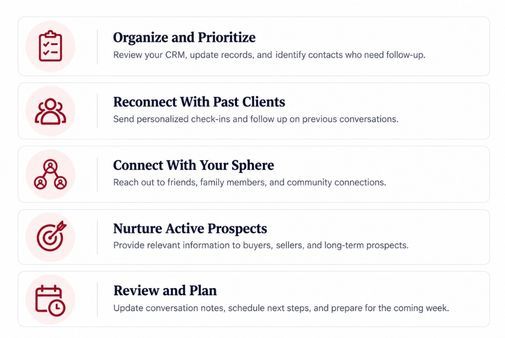
A database strategy becomes more effective when you use it consistently.
You don't need to spend hours every day managing contacts. Instead, create a repeatable routine that fits your schedule.
Consider dedicating approximately 30 minutes each workday to database-related activities.
A Simple 30-Minute Daily Database Routine
☛ Minutes 0–5: Review Your Contacts
Check your CRM reminders, recent conversations, and priority follow-ups.
☛ Minutes 5–20: Complete Personalized Outreach
Make phone calls, send messages, or respond to contacts who need assistance.
☛ Minutes 20–25: Update Your CRM
Record relevant conversation notes and update contact information.
☛ Minutes 25–30: Schedule Next Steps
Create follow-up reminders and identify contacts for your next session.
The purpose of this routine isn't to complete a specific number of sales calls.
It's to develop a consistent habit of maintaining relationships and following through on commitments.
Track Meaningful Activity, Not Just Message Volume
Instead of focusing only on how many people you contacted, consider tracking:
✔ Meaningful conversations completed
✔ Follow-up commitments fulfilled
✔ Appointments requested or scheduled
✔ Referrals received
✔ Relationships reestablished
✔ Next steps recorded in your CRM
These metrics help you evaluate whether your activities are producing useful conversations and business opportunities.
30-Minute Real Estate Database Audit Worksheet
Not sure where to start?
Use this simple worksheet to review your existing database and identify immediate opportunities to improve your follow-up process.
You can complete the exercise using your CRM, spreadsheet, or current contact list.
What Should You Do After Completing the Audit?
Once you've finished, review your findings.
You may discover that several past clients haven't received a check-in recently. You might find incomplete contact records or prospects who need updated follow-up reminders.
Choose one manageable action and complete it.
Then schedule another short database session.
The goal is progress, not perfection. A consistently maintained database is more useful than a complicated system that rarely gets updated.
Common Real Estate Database Marketing Mistakes to Avoid
Even experienced agents can develop habits that limit the effectiveness of their database marketing.
Recognizing these mistakes can help you build a more sustainable process.
1. Only Reaching Out When You Need Business
If people only hear from you when you're looking for referrals or transactions, your communication may feel transactional.
Make relationship-building a regular part of your business, not something you do only during slower periods.
2. Sending the Same Message to Everyone
A homeowner, first-time buyer, and personal friend may have very different interests.
Use contact segmentation to make your communication more relevant.
3. Forgetting to Record Conversations
Without updated CRM notes, you may forget what someone shared or when you promised to follow up.
Record relevant details after meaningful conversations and create reminders when appropriate.
4. Making Your Follow-Up System Too Complicated
You don't necessarily need complicated automations or numerous campaigns to maintain strong relationships.
Start with a process you can realistically follow.
As your business grows, you can evaluate whether additional tools would improve efficiency.
5. Ignoring Communication Preferences
Not everyone wants to receive marketing emails, text messages, or frequent calls.
Respect contact preferences, honor opt-out requests, and follow applicable marketing and privacy requirements.
Agents should also review their brokerage's communication policies and applicable federal and Maryland requirements before conducting marketing outreach.
How the Right Brokerage Environment Can Support Your Business Growth
Developing consistent database habits is an important part of building a real estate business.
But agents may also benefit from evaluating the professional environment in which they work.
Whether you're a newer agent learning how to build relationships or an experienced agent refining your systems, it's worth considering how your brokerage aligns with your goals.
When evaluating a real estate brokerage, ask questions such as:
-
What resources are available for database organization and client relationship management?
-
What professional development opportunities can agents explore?
-
How does the brokerage approach business planning and accountability?
-
What expectations exist around client communication and service?
-
Does the environment align with the type of real estate business I want to build?
These questions can help you make an informed decision about your professional direction.
For agents working in St. Mary's, Calvert, and Charles Counties, understanding the local market and developing lasting community relationships are especially relevant considerations.
At The Southside Group Real Estate, we believe that clear communication, professional growth, preparation, and putting clients' interests first are important foundations for serving our community.
Agents interested in learning more about our team can explore our career opportunities and determine whether our approach aligns with their professional goals.
Your Next Opportunity May Start With a Simple Conversation
Generating business from your real estate database isn't about sending more messages or constantly asking for referrals.
It's about building a system that helps you maintain meaningful relationships.
Start by organizing your contacts. Segment your database so your communication stays relevant. Reconnect with past clients, nurture your sphere of influence, and create a weekly routine you can maintain.
Most importantly, focus on being helpful.
Your database doesn't need to be perfect, and you don't need hundreds of contacts to get started.
Sometimes, the most productive next step is simply reaching out to someone you haven't spoken with in a while.
Start with five contacts this week. Have genuine conversations, follow through, and build from there.
Build Your Real Estate Business With Intention
Building a successful real estate business takes more than collecting leads. It requires meaningful relationships, consistent follow-up, and a clear plan for long-term growth.
If you're a real estate agent in Southern Maryland considering your next professional step, explore The Southside Group Real Estate and learn more about our team and career opportunities.
FROM OUR BLOG

Golden Beach Real Estate Market Update | October 19, 2026
The Golden Beach real estate market update for October 19, 2026, highlights a limited selection of available homes and an equal number of properties currently under contract. According to the market figures supplied for this update, Golden Beach in Mechanicsville, Maryland, has just 3 active listing

How Long Does It Take to Buy a House?
How Long Does It Take to Buy a House? What Southern Maryland Buyers Should Know How long does it take to buy a house in Southern Maryland? For most buyers, the process is better measured in stages than by one fixed number of days. You need time to prepare financially, get pre-approved, find the righ

Moving Timeline: When to List Your Home for Maximum Profit 2026
Best time to sell a house is one of the most important questions Southern Maryland homeowners ask when they know a move is coming. Listing too early can leave you scrambling to prepare, while waiting for a supposedly “perfect” month could mean competing with more homes or missing a window that bette